|
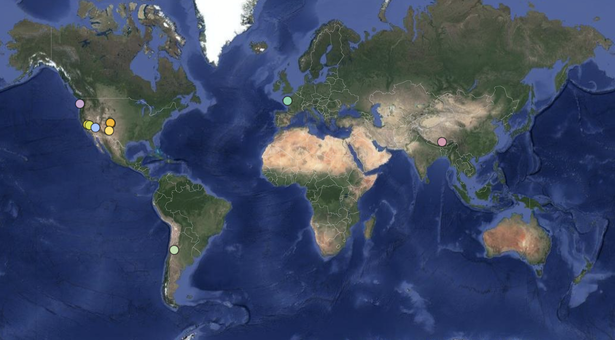
My geologic research is split between field work and lab work, with a smattering of computational work. Regions of interest include more local areas in the western U.S. as well as several international sites with active tectonics.
My science education research focuses on student research and field experiences as a means to increase students' sense of belonging and prepare for careers in Earth science. |
Current Research Projects
|
Tectonics & Chronology Research
Tectonic growth of the Andean Precordillera
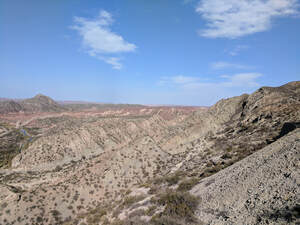
Exploration of fault growth patterns and surface processes by combining low-temperature thermochronometry and cosmogenic radionuclide dating to evaluate erosion rates at different spatial and temporal scales: Andean Pre-cordillera fold-thrust belt (D. Granger, D. Shuster, V Ruiz: CSULB Graduate Student, P. O'Sullivan).
Paleo-topography and Paleo-altimetry: Rocky Mountains and Great Plains

Determining the role rifting and fault growth plays in basin connectivity and drainage pathways, through sedimentary analysis, provenance studies, and fault growth across accommodation zones. (A. Tye, AGeS Cohort (CSULB and UT Tech Undergraduates), N. Niemi, G. Gehrels). Fault growth and basin integration in the western US
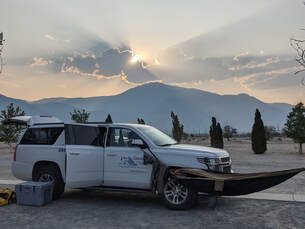
Integration of stratigraphic and fossil characterization, fault growth analyses, and paleo-climate proxies to assess tectonic and climatic drivers for Miocene mammal migration in the Basin and Range, US (K. Loughney, Roxy Schulman, Amanda Carranco & Jennifer Sanchez (CSULB undergraduate students))
Low-temperature thermochronology modeling methods
Numerical thermal history modelling has become a core approach used for interpretation of low-temperature thermochronometry data. I have several projects dedicated to the continuing development of better practices for modeling and data collection & reporting (D. Westby, K. Murray, A. Stevens-Goddard, M. Wildman).
|
Science Education Research
Development of Universal Skills
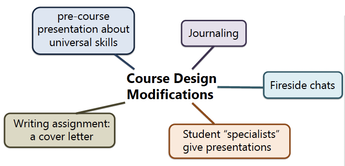
Making incremental changes to field courses, following the UFERN model, to increase development of universal skills and student self-advocacy. Evaluation of these changes and their effects is on-going using pre- and post-surveys as well as analysis of student writing projects (J. Gutierrez, S. Doser)
Using student Context Factors to Design and Advertise New Courses
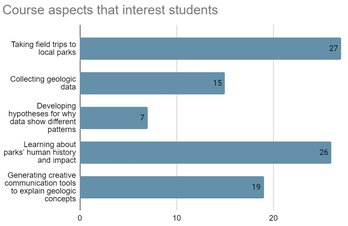
When courses are intended to increase interest and participation in STEM, do they consider student context factors when designing those courses? We ask why students sign up for certain courses and what components of those courses contribute to feelings towards STEM subjects (J. Ancayan: CSULB graduate student).
Geology of Local Parks class changing students' perceptions of STEM fields
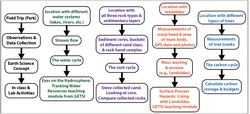
Using a flipped model for introducing students to field trips, data collection, lab work, data interpretation, and science communication, combined with a deep look into human impacts at local and national parks, this project aims to increase student awareness of Earth Science applications, increase science literacy, and build recruitment into STEM and especially Earth Science disciplines (J. Ancayan: CSULB graduate student & E. Palma CSULB undergraduate student)
|
Past Research Projects
|
Low-temperature thermochronology modeling methods

This project focuses on determining good practices for inverse and forward modeling such data, as well as developing education tools for those new to modelling low-T thermochronology data (K. Murray, A. Stevens-Goddard, M. Wildman).
|
Tracking Water-Rock interaction
|


|
Continental Rifting: Rio Grande rift
During my PhD I worked understanding the development of the the Rio Grande rift and addressing the growth debate (synchronous vs propagating rift) using low-T thermochronometry and spatiotemporal analysis of magmatism (N. Niemi).
|
Southern Rocky Mountains, CO
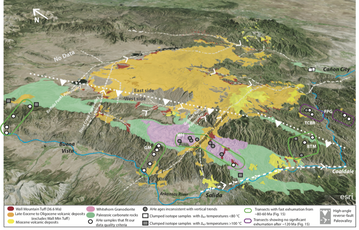
Multidisciplinary work from my PhD revealed differential exhumation in the southern Rockies, during the Laramide Orogeny, insights into paleo-topography during the early Cenozoic, formation of the regional Eocene erosion surface, and evidence for top-down resetting of low-T thermochronometers (N. Niemi, I. Winkelstern, J. Geissman, M. Heizler)
|